
Long County VINELink Coverage
Georgia VINE/VINELink provides free, secure, confidential access to participating custody and criminal-case information, notification registration, and victim services. It is an alert and current-status layer. It is not the Long County sheriff's release log, the GDC sentence file, or the court docket.
Long County's housing arrangement makes the agency field vital. The sheriff says the county does not operate an active jail facility and instead houses detainees in surrounding county jails. VINELink may identify the agency or facility feeding the record rather than display a simple “Long County Jail” label. Confirm the result with the listed custodian and compare it with the Long County housed-in note.
No source confirms that every surrounding housing jail reports every event through VINE in the same way. A missing result cannot prove that no Long County arrest or release exists.
Search Long County VINELink Records
Start with the official Georgia landing page and search one person. Use an ID when known, since common names and spelling differences can produce uncertain matches. Read the agency before assuming the result comes from the county sheriff.
- Open Georgia VINELink and choose the custody or offender search.
- Enter the person's name or identification number.
- Try a careful spelling variation if no result appears.
- Compare each match by available identity details.
- Open the specific result and record the status, agency, facility, and ID.
- Compare a neighboring-jail result with the Long County roster's housed-in note.
- Verify release or transfer with the agency responsible for that custody event.
The Long County released-inmate search adds sheriff records, court disposition, GDC, BOP, and immigration routes when VINELink does not resolve the person.
The official Georgia VINELink source is shown below so users can recognize the correct state search entry.
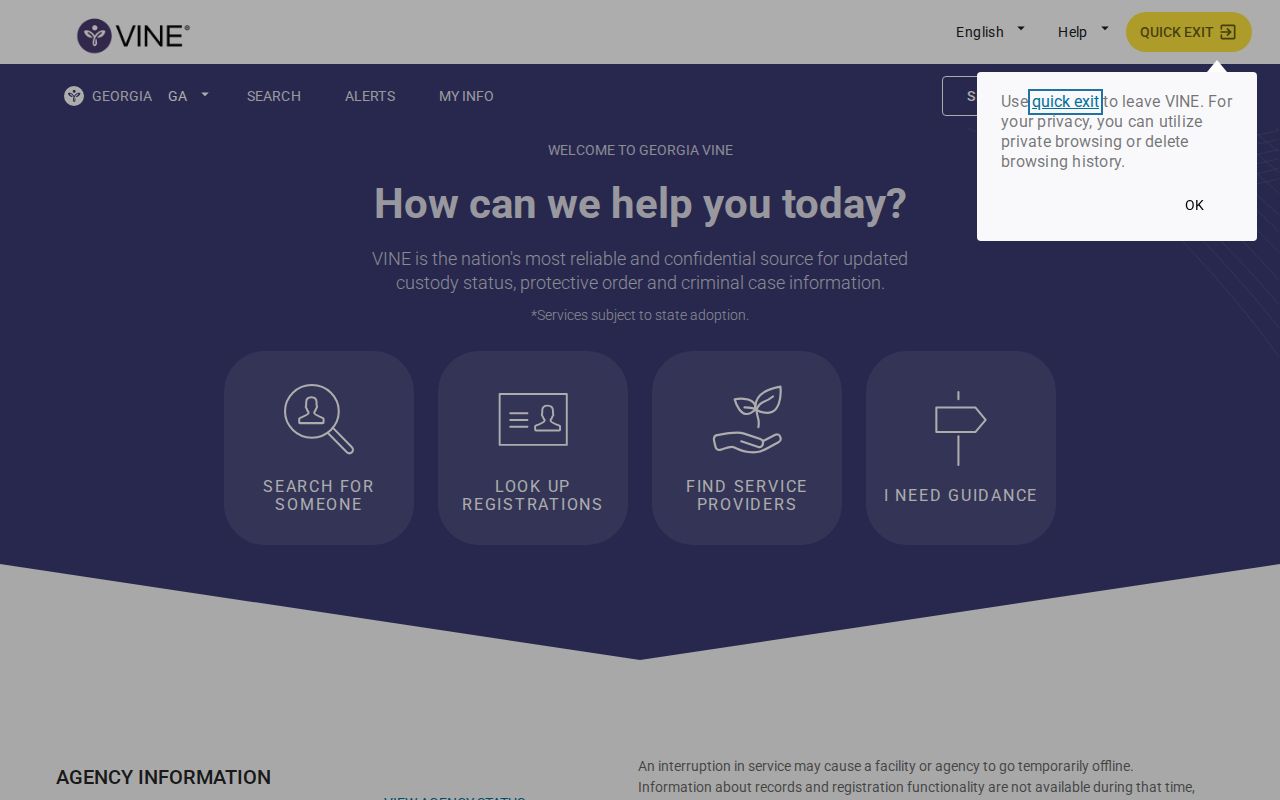
The state landing screen is the right starting point for a county or Georgia custody alert, not a commercial people-search result.
Long County VINELink Release Fields
A public result should be read as a status report from the participating source. Exact labels can vary. A released result may say no longer in custody, released, or transferred. That wording does not explain every bond, court, sentence, or hold event behind the change.
| Field | What it helps confirm |
|---|---|
| Name or offender ID | The identity tied to the result. |
| Custody status | Whether the source reports custody, release, or transfer. |
| Agency or facility | The office that should verify the reported event. |
| Custody event | A change that may trigger an alert. |
| Notification option | Whether alerts can be registered for that record. |
VINELink is not a historical archive. It also is not the official court disposition. For a Long County arrest, the sheriff record supplies booking, status, bond, charge, court, and housed-in context. For a state prisoner, GDC supplies sentence and release-date fields.
Register Long County Release Alerts
Registration begins inside the correct person's official result. Available methods may include phone, email, text, or another option shown by VINELink. Enter contact details only on the official service and save the confirmation information.
- Open the matched person's record.
- Select the register or notification control.
- Choose an available phone, email, or text method.
- Enter the destination on the official site.
- Create a PIN or confirmation code if prompted, especially for phone calls.
- Complete the confirmation step and retain the registration details.
- When an alert arrives, verify it with the sheriff, housing jail, GDC, or court.
The PIN helps confirm receipt and can stop repeat phone notifications. It is not an inmate PIN, release code, or court identifier. Do not give it to someone claiming to arrange release.
Note: Holds, court orders, and transfers can change the meaning or timing of an alert after the original custody source sends it.
Confirm Long County VINELink Alerts
For a county arrest, compare the alert with the Long County Interop roster. Its current, 24-hour, and arrest-date views can show RELEASED status, arrest date, days in jail, total bond, charge, court, and housed-in notes. Then contact Long County about Long County holds or records and the housing jail about physical release.
For state-prison custody, use the GDC Find an Offender search. GDC records may show state status, location, sentence details, maximum release date, and actual discharge information. The GDC page directs users to verify important details with Inmate Records and Information.
Court records answer a different question. They show the legal outcome, including bond orders, disposition, sentence, probation, dismissal, or later warrant activity. VINELink cannot replace that docket.
Missing Long County VINELink Results
“Not found” has several possible causes. The name may differ, the status may have changed recently, the surrounding jail may not expose the event as expected, or the person may be in GDC, federal, or immigration custody. A released person may also have aged out of a current-status system even though the sheriff and court records remain.
- County detainee
- Use Long County Interop, the sheriff's records page, and the named housing jail.
- State prisoner
- Use GDC, then parole and DCS tools where supervision follows.
- Federal inmate
- Use the BOP locator, which includes released federal records from 1982 forward.
- Immigration custody
- Use ICE ODLS or DHS VINE, which are separate from Georgia VINE.
A registry is also separate. Long County links SheriffAlerts for people subject to sex-offender registration, but that is not a general release list and does not apply to all released people.
Federal Versus Long County Alerts
Georgia VINELink does not replace the federal Bureau of Prisons locator. The BOP Find an Inmate tool can show a federal person as released or not in BOP custody, often with a release date. That result proves federal custody status, not release from a Long County booking.
Immigration notification has its own path. DHS VINE covers federal immigration custody notifications, while ICE ODLS is the detainee locator. A Long County status can change to released when another authority takes custody, so these systems should be checked only when a hold or transfer makes them relevant.
The official DHS VINE interface is shown below to make the separation clear.
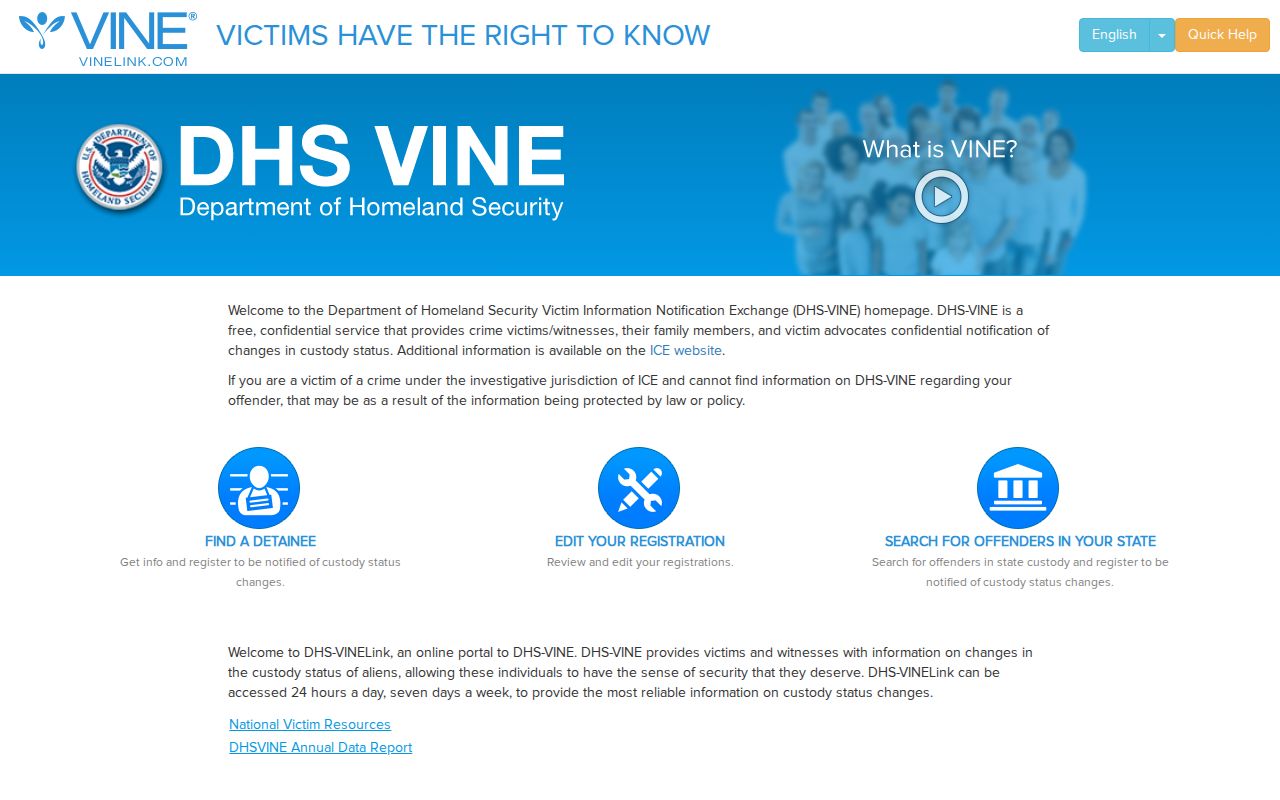
DHS VINE is not the Georgia county-jail search. Its separate federal role prevents a state no-result from being treated as the end of the search.
Long County Housing Jail Alerts
Long County detainees may be physically held in Appling, Tattnall, Wayne, McIntosh, Ware, or another surrounding jail. The Long County Sheriff's Office remains the local records and hold agency for Long County charges, while the outside jail may control the actual release gate and property handoff.
This split explains why an alert should be checked against two sources. Match the VINELink facility to the roster's housed-in note. Ask that facility about immediate physical custody. Ask Long County whether its hold cleared and how to obtain the release record. A court clerk remains the source for the order and case outcome.
VINELink adds speed, but agency records add meaning. Using both avoids mistaking a transfer, delayed update, or missing result for a final answer.
Long County Alert Event Scope
An alert reports the event sent by a participating agency. Release, transfer, and other custody changes can have different practical results. A transfer alert may mean the person remains confined elsewhere. A release alert may reflect departure from the reporting jail while a second hold takes effect. The message should trigger verification, not replace it.
Write down the alert time, named facility, status wording, and offender identifier. Then check the matching official system. Long County handles its charge and hold record. The surrounding jail handles the physical custody event it performed. GDC handles a state prison record, and the court clerk handles the case order. This chain is especially important when family members are arranging transportation or trying to confirm where the person went.
VINELink may not show the final release reason. Bond, sentence completion, court order, parole, probation, or transfer can require separate records. A county status also should not be used to predict a state maximum release date or Tentative Parole Month.
VINELink Versus GDC Release Records
Georgia VINE and GDC serve different purposes. VINE provides status access and notifications. GDC's offender detail is the stronger public route for a person who entered Georgia prison custody, including someone released from Long Unit in Ludowici. That record may display location, sentence information, maximum release date, or actual discharge status.
A Tentative Parole Month is not the same as a release alert. It is a planned month for Board review and may change due to conduct, programs, or another decision. After actual release to parole, the Board's parolee search and the Department of Community Supervision become relevant. Long County is served by the DCS Claxton field office for state supervision.
County detainees should not be pushed into GDC merely because Long Unit is located in Long County. Long Unit is a state prison. The Long County roster covers sheriff arrests and housed-in county detainees. The correct system follows custody type, not geography alone.
The same rule applies after release. A GDC discharge may lead to parole or felony supervision through state tools. A Long County bond release may lead back to a county court date. A neighboring jail's gate release may still leave an active Long County case. VINELink can flag a change, but it cannot merge these separate records into one legal history.
For precision, keep the offender ID and agency name from each result. IDs are more reliable than a familiar name, and the agency label tells the user which office can correct or certify its own information. If an alert conflicts with a live roster, contact both sources and ask about the event time, transfer, and any remaining hold.