
Understanding Long County Releases
“Released” means one agency no longer holds the person under the booking being checked. It does not always mean the person walked into the community with no further duty. A Long County arrestee may leave on bond, complete a short sentence, move to another county, enter Georgia Department of Corrections custody, or be delivered to another authority. The public Long County booking record may change its status to RELEASED. Court, bond, transfer, and supervision records then explain what followed.
Long County has an unusual custody system. The Sheriff's Office jail and bonding page says the county does not operate its own jail. People arrested on Long County charges are housed in surrounding county jails. Thus, the agency holding the arrest and bond record may differ from the jail handling the physical departure, property return, and gate time. A release check must keep those two roles apart.
- Bond
- Security that permits pretrial release while the case continues.
- Time served
- Release after the custodial sentence has been completed.
- Parole
- Discretionary prison release under state supervision.
- Probation
- A court-ordered term served in the community.
- Discharge
- The end of custody or supervision shown by the responsible agency.
The booking status is the first clue, not the last answer. A person marked released may still have an open case, a probation term, a parole condition, or a duty to report elsewhere. The source that created each event remains the best source for it: the sheriff for the county arrest and hold, the clerk for the court order, GDC for a prison sentence, and the Parole Board or DCS for state supervision.
Identity must also be checked before records are combined. Use a full legal name, birth date when known, booking or warrant number, court case number, and GDC ID when applicable. Match more than a name before treating one entry as the person sought.
Long County Release Types
The reason for release controls the next useful record. Long County's public roster does not show every release reason, so a status line should be matched with the bond, court, jail, or corrections record. The main paths are different enough that guessing from an empty roster can be misleading.
| Release path | Meaning | Next record |
|---|---|---|
| Cash, property, or bail bond | Pretrial custody ends while the charge remains open. | Booking entry, bond order, court docket |
| Sentence expiration or earned time | A county sentence ends after lawful credit. | Sentencing order and jail release log |
| Dismissal, no bill, or acquittal | The charge ends without conviction. | Clerk's disposition |
| Transfer to GDC | County custody ends as state custody begins. | GDC offender record |
| Parole or probation | Community supervision follows custody. | Parolee database or supervision office |
| Another hold | One release leads directly to other custody. | Receiving agency and transfer notation |
A death in custody can also close an entry, but it should never be inferred from a roster change. Likewise, a person transferred from a housing jail may still face a Long County hold even though the person left that building.
Pretrial and post-sentence releases require different follow-up. A bond release directs the search toward the bond order and pending docket. Sentence completion directs it toward the judgment, credited time, and jail discharge record. A transfer points toward the receiving agency. Parole points toward a Board decision and community-supervision record.
For Long Unit, use state terminology. GDC defines Max Out or MRD as the maximum release date, while the Parole Board uses Tentative Parole Month for parole planning. Neither term should be substituted for the actual date on which custody changes.
Where Long County Releases Happen
The release gate may be outside Long County. The sheriff lists Tattnall, Wayne, Appling, McIntosh, and Ware county jails as housing sites. A housed-in note identifies the likely physical custodian. That jail can address departure time, personal property, and pickup rules. Long County remains the source for the Long County arrest status, holds, bond routing, and local records.
A housing jail can confirm that a person left its building while the Long County Sheriff's Office confirms whether the Long County hold cleared. If the two answers seem to conflict, ask whether the person transferred, whether another warrant or detainer applies, and which agency received custody. “Released” from one facility can describe a transfer rather than freedom into the community.
Note: Check the housed-in note before arranging transportation, since the physical release point may be far from Ludowici.
All Long County inmate holds must pass through the Sheriff's Office even when another jail supplies the bed. The housing jail can answer questions about its gate procedure, stored property, and pickup instructions, but it cannot erase a separate Long County hold on its own.
For a same-day release, ask whether processing is complete, whether transport between agencies is pending, and whether a release time is available in the public record. Do not promise a pickup time from a bond receipt or court order alone because administrative steps can remain.
Who Sets Long County Bonds
Long County's bond process is court driven. The Sheriff's Office states that it does not set bonds. Magistrate, State, or Superior Court sets the amount and terms. A cash, property, or bail bond can lead to a released status, yet the underlying case and court dates continue. The release entry is only one part of the record.
The current instructions say no bonding company operates in Long County, so approved companies from surrounding counties may be used. The page describes a nonrefundable fee of 12 to 15 percent when a bail bondsman posts the full amount. Verify the approved list and exact charge before payment. Court-date questions go to the clerk, not jail staff.
The sheriff describes cash, property, and professional bail-bond routes. The correct route depends on the court's order. Never assume that a quoted bond amount is the final amount due without checking for more than one warrant or charge.
A denied bond or a bond not yet set can explain why a person remains in custody. If the roster and paperwork differ, ask the court for the filed order and ask LCSO whether all Long County holds have been addressed.
What Long County Release Records Show
A local release record may be a set of linked records, not one public certificate. The InteropWeb entry supplies the arrest and custody frame. The internal jail log may add the precise discharge time and authority. A bond order or court docket identifies the legal event. When a public row has vanished, a records request can ask for the missing pieces.
| Field | What it can establish |
|---|---|
| Name and identity | Which booking belongs to the person |
| Status | Currently booked or released |
| Arrest date and agency | When custody began and who arrested |
| Days in jail | The roster's displayed stay |
| Total bond | Amount, denied, or not set |
| Warrant, statute, and charge | Legal basis for the booking |
| Court | Office holding the case record |
| Housed-in note | Neighboring jail with physical custody |
| Release date, time, authority | Details to request if not public online |
The public text view does not expose a distinct release time or reason for every row. Never treat bond data alone as proof of how release occurred. Court action, sentence completion, another hold, or transfer may explain the change.
A useful release record connects the beginning and end of custody. Arrest date and agency identify the event. Charges, statutes, warrant numbers, court, and bond identify the legal track. Status and housed-in notes describe custody. The requested release time, authority, transfer destination, and final hold status explain how it ended.
Not every field will be maintained in one database. Ask for existing records rather than requiring a new report. If a field is absent, request the source document likely to contain it, such as a bond order, release log, transport entry, sentence, dismissal, or disposition.
Request Long County Release Records
The Long County local records page describes a Local Records Only search. It covers law-enforcement contacts and arrest records kept within the Sheriff's Office jurisdiction. Ask for the releasable booking and discharge material with enough detail to locate the event.
- Give the full name, birth date if known, arresting agency, and approximate arrest date.
- Ask for the booking number, final custody status, release date and time if maintained, and release authority if releasable.
- Request bond, housing-jail, transfer, and hold notations.
- Ask for a cost estimate and state whether an electronic copy will work.
- If court action caused release, request the matching order or disposition from the clerk.
6 East Academy Street
P.O. Box 368
Ludowici, Georgia 31316
912-545-2118
Administrative hours: 8:00 a.m. to 5:00 p.m. daily
The Georgia Open Records Act sets the response framework. An agency generally must produce records within a reasonable time not exceeding three business days, or provide a description and timeline within that period. Normal letter or legal-size copies are capped at ten cents per page. A cost estimate is required above $25, and prepayment may be required above $500.
A focused request reduces delay and cost. Ask for one named person and an approximate date range. State that an electronic copy is acceptable if true. If the person was housed elsewhere, ask LCSO to identify that jail and say which responsive records it maintains.
For a state-prison discharge, use GDC. Its disclaimer directs written verification to Inmate Records and Information, P.O. Box 1529, Forsyth, GA 31029. For a court result, contact the Long County clerk. Keeping requests with the record owner avoids incomplete county answers about state custody.
Long County Release Record Laws
O.C.G.A. § 50-18-71 makes public records available unless an exemption applies and governs timing, estimates, and copy charges. A denial should identify its legal basis. The law does not mean every field must appear on a live roster. It provides a route to request releasable records from the office that maintains them.
Retention differs by system. The current-inmate page is live, the 24-hour page is a short booking window, and the arrest-date tool offers a broader search based on arrest date. Court and GDC files provide a longer trail. Record restriction, sealing, or expungement can change public access, but release alone does not erase an arrest entry or court file.
Can an empty roster prove release? No. A missing name may reflect transfer, spelling, delay, or short web retention. Confirm the status in an agency record.
Georgia record restriction concerns qualifying criminal-history information, while sealing and court access can involve separate procedures. Release does not establish eligibility. The final disposition matters, and the court or agency applies the governing rule to the case.
Booking photographs have an additional rule. O.C.G.A. § 35-1-19 limits law-enforcement posting and release in circumstances tied to publication that charges for removal. Those photo rules do not replace the ordinary release-record request.
Find a Released Long County Inmate
Start with custody type. A Long County arrest belongs in the sheriff's tools even when a neighboring jail supplied the bed. A state-prison case belongs in GDC. Federal and immigration cases use national locators. Court records explain the legal result.
- Search the Long County current roster and note status and housing.
- Check the last-24-hours booking page for a recent released status.
- Use Inmates by Arrest Date for a wider booking range.
- If the person entered state prison, use GDC and Parole Board tools.
- Check court records for bond, disposition, sentence, revocation, or transfer.
- Use VINELink for alerts, then verify with the agency.
- Request the record when online details are gone.
The Long County 24-Hour Release List explains why the local same-day tool is a booking feed, not a true release-only list.
Search spelling variants cautiously. A middle name, suffix, or data-entry difference can hide the correct row. Compare the arrest agency, date, court, charges, and housed-in note. If the tools return nothing, call LCSO and ask whether the person was booked, transferred, released, or entered under another spelling.
The date-range tool searches arrest dates, not release dates. Someone released today after an older arrest will not necessarily appear in a short arrest window. Use the known booking date when possible; otherwise, the records request and court docket are stronger fallbacks.
Georgia Search for Long County Releases
The Georgia Department of Corrections Find an Offender tool covers state prisoners and retained state offender records. It is not the Long County jail roster. Use it when a Long County defendant transferred to GDC or when checking a person released from Long Unit.
| Search detail | Use |
|---|---|
| Name | Starts a search without an ID |
| GDC ID or case number | Separates similar names |
| Age and identifiers | Matches the correct result |
| Facility and status | Shows placement or released status |
| Sentence and release fields | May show maximum, parole, or actual release data |
GDC warns that photos display automatically when available and directs verification to Inmate Records and Information at P.O. Box 1529, Forsyth, GA 31029. The official search form illustrates the state route.
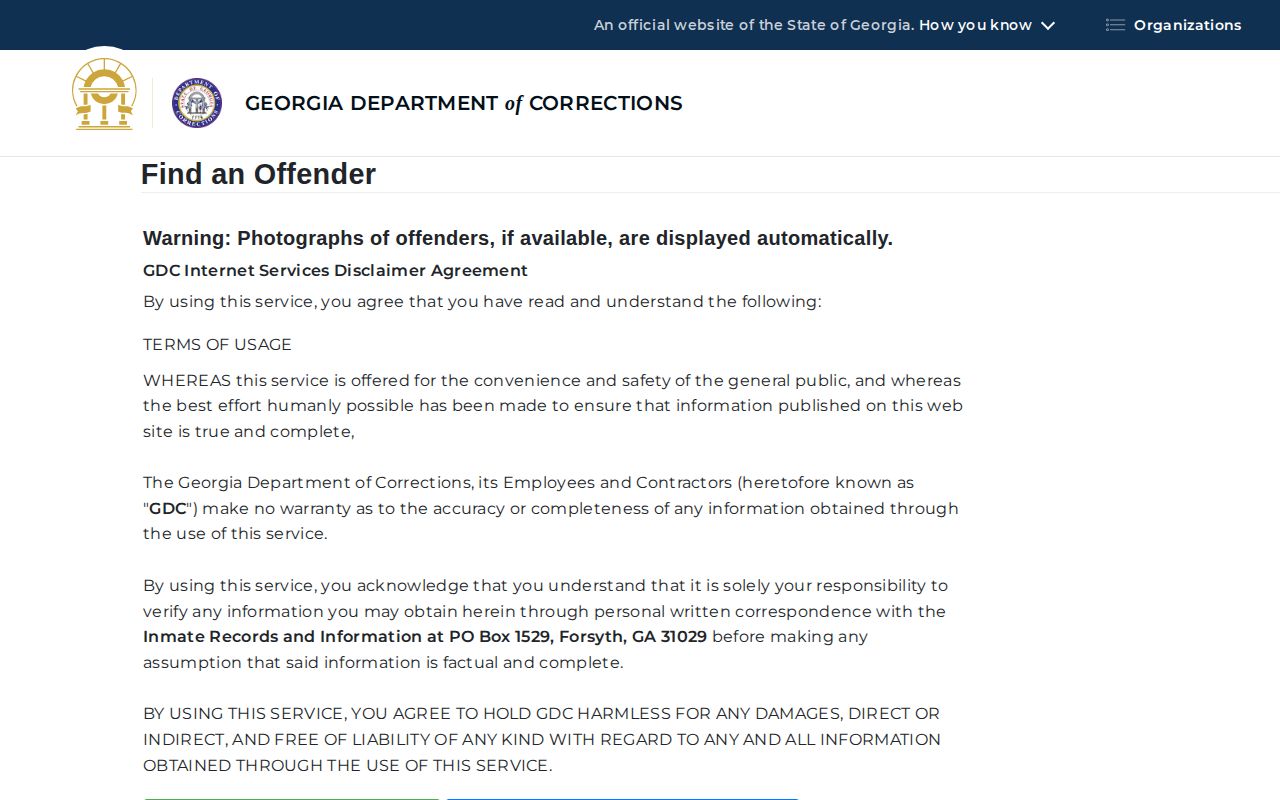
Use this form for GDC custody and the Long County roster for county arrests.
Start the state search with the strongest identifier available. A GDC ID or case number is more precise than a common name. When searching a name, compare age, physical details, facility history, sentence data, and status. A photograph may display automatically, but it should not replace record matching.
Read each state field in context. Current placement answers where GDC reports the person. A released or discharged status concerns state custody. Max Out or MRD describes the sentence maximum. A TPM comes from the Parole Board and remains tentative. None proves the result of a separate Long County charge.
Long County Recent Release Workaround
Long County has no dedicated release-only list. Its “Inmates Booked Last 24 Hours” page can show currently booked and released statuses, but it helps only when the booking falls inside that short window. The date-range page is the better weekend or known-arrest-date option, though it is keyed to arrest date.
No official refresh interval or retention period was found. Capture the status, arrest date, days in jail, bond, court, charges, and housed-in note. Then call the correct office when timing matters. A housing jail addresses physical release, while Long County handles the local hold and record.
The last-24-hours label defines a booking window. It can reveal a fast release when a newly booked row already says RELEASED, but it cannot find all people released that day. The arrest-date tool can display released rows over a selected range, yet it remains an arrest-date search.
For a weekend check, search wide enough to include the expected arrest, then compare the identifiers. Verify status and any transfer with LCSO or the named housing jail, especially when the row shows an outside facility.
Long County Post-Release Supervision
Georgia splits supervision among three systems. The State Board of Pardons and Paroles decides parole and provides TPM and parolee tools. The Department of Community Supervision handles adult felony probation and parole in the community. Long County Misdemeanor Probation serves local misdemeanor cases.
The DCS Claxton Field Office serves Long County. A released state prisoner can first be checked in Parolee Search, then matched to DCS. A local misdemeanor case belongs with the courthouse office. The Long County parole and probation page separates these routes.
The Parolee Search accepts name, race, case number, UPI number, or GDC ID. For an incarcerated state prisoner, TPM Lookup uses an inmate number, GDC ID, or personal data. A TPM is a planning month, not a guaranteed release date, and misconduct can postpone or cancel it.
DCS Claxton is the field office for Long County state supervision. Long County Misdemeanor Probation is a separate courthouse office. Identify whether the sentence is felony state supervision or local misdemeanor probation before calling.
Long Unit Release and Reentry
Long Unit creates a second release system inside the county. GDC describes the Ludowici prison as a medium-security state facility for adult men and says its mission includes reentry classes. Those programs apply to state prisoners, not to county arrestees housed in neighboring jails.
A Long Unit release should be followed through GDC status and sentence fields, the Parole Board if parole applies, and DCS if supervision follows. The Long County booking feed is the wrong tool unless the person also has a county booking or hold.
GDC lists Long Unit at 1434 US Hwy 84 East in Ludowici. Its local location can create a search trap because a prison inside Long County is not part of the Sheriff's housed-inmate roster. Long Unit has its own GDC custody chain and state release process.
GDC says Long Unit provides reentry classes and programming intended to give offenders tools for return to society. That state-prison work does not describe the release services or timing for a county arrestee housed in a neighboring jail.
Long County Release System History
The original Long County jail was in the courthouse and permanently closed after an early-1980s fire. The county did not restore an operating jail there. That history explains why a modern release record and physical custody can point to different agencies.
The arrangement affects every search. LCSO maintains the Long County arrest, bond routing, holds, and records, while surrounding jails provide housing. Begin with the local record, then follow its housed-in note to the facility that may handle gate release and property.
Long Unit Release Search Trap
Long Unit is a GDC state prison for adult male felons. Its Ludowici address does not make its prisoners county-jail detainees. Search GDC for state status, use the Parole Board for TPM and parole decisions, and use DCS when state supervision follows.
A Long Unit prisoner appears in InteropWeb only if a distinct county arrest or hold creates a local record. Without that event, the 24-hour booking page cannot confirm a prison release. Long County may be only the facility's geographic location.
Long County Release Alert Channels
Georgia VINE/VINELink offers custody status, case information, and confidential notifications. Search a known person, register through the official result, and verify an alert with the named agency. Since Long County uses neighboring jails, VINE may name the physical housing jail.
Federal custody requires the BOP locator, which includes released federal inmates from 1982 forward. Immigration custody uses ICE ODLS or DHS VINE. No source shows that Long County operates a federal or ICE facility, so use these paths only when a record shows such a transfer.
A BOP result may say Released or Not in BOP custody and may provide a release date. That confirms federal status, not release from a Long County charge. ICE ODLS checks immigration detention, while DHS VINE handles immigration custody notifications. Georgia VINELink and DHS VINE are separate.
A county RELEASED status can mean release to a federal or immigration authority. Ask LCSO which agency received custody and then use that agency's locator. No county-specific U.S. Marshals release feed was found, so follow a federal hold through the agency identified in the record.
Georgia VINE is not a historical release archive and does not replace GDC sentence data or a court disposition. Register from the specific person's result, choose the available phone, email, or text method, and create a confirmation code when requested. When an alert arrives, verify it with the sheriff, housing jail, GDC, or other agency named in the result.
A no-result response does not prove that no Long County case exists. The person may be listed under another spelling, recently moved between systems, outside VINE coverage, in federal custody, or present only in a court record. Return to the county record and follow any transfer notation before choosing a national locator.
Compare Long County Custody Records
Each source answers a narrow question. Use the office that owns the custody event rather than treating one empty result as final.
| System | In custody | After release |
|---|---|---|
| Long County roster | Shows booked status and housing | Name may vanish or status may change |
| Booking/date views | Can show current rows | Can show released status in the booking window |
| Court or release record | Explains an order | Shows bond, transfer, sentence, or disposition |
| GDC search | Shows state placement | May retain state discharge data |
| VINELink | Provides status and alerts | May alert to release, but is not an archive |
| BOP or ICE | Checks the matching federal system | Shows changed federal status when available |
A two-source check is useful when the result matters now. Pair custody with the legal source: roster plus court, GDC plus Parole Board, or county transfer notation plus the receiving locator. Record when each source was checked because live status can change.
Does RELEASED mean no one holds the person? Not always. It can mean only that the named agency ended custody. A transfer, detainer, warrant, prison commitment, or immigration handoff may follow.
The comparison also explains which result should survive after time passes. A live roster is designed for current custody. A short booking view has a limited window. The court disposition and requested release record preserve the legal and custody outcome. GDC retains state correction information, while BOP can report federal releases from its covered period.
If records disagree, ask the owner of the disputed field to reconcile it. The clerk owns its filed order, LCSO owns its Long County arrest and hold record, the housing jail owns its physical custody event, and GDC owns the state sentence record. Do not average dates or choose the result that appears most favorable.
Long County Court After Release
Release does not close the court case. The Sheriff's Office says it does not notify people of court dates and directs those questions to the clerk. The Long County Clerk profile covers Superior, State, and Juvenile records. Superior Court handles felony matters in the Atlantic Judicial Circuit.
Look for the case number, bond order, hearing date, disposition, sentence, probation term, warrant, revocation, dismissal, nolle prosequi, or acquittal. Georgia's court e-access entry point routes users to an account-based provider. If the online result is incomplete, contact the clerk at 912-545-2123.
LCSO says it does not notify people of court dates. A person released on bond must obtain dates from the clerk. Missing court can result in a warrant, and probation-rule failures can also produce warrants. A prior release record does not prevent a later wanted status.
The sheriff says received warrants are entered in its database and placed in GCIC and NCIC. Confirm an apparent warrant with the sheriff or issuing court. The warrant record, docket, and custody record document different stages.
The Long County Clerk of Superior Court profile lists 458 South McDonald Street, P.O. Box 458, Ludowici, Georgia 31316. Its published hours differ on Friday and include a noon closure, so check current access before visiting. The clerk manages Superior, State, and Juvenile records, while the sheriff's Superior Court page identifies felony jurisdiction and the Atlantic Judicial Circuit.
Georgia's e-access entry point sends users to a provider that requires an account, and participating coverage can vary. If a case is absent online, the clerk remains the direct source. Provide the party name and case number when known and ask for the disposition, sentence, bond order, or later modification that explains the custody outcome.
Verify a Long County Release Result
Finish the search by writing a short source trail. Record the exact name and identifier matched, the Long County booking status, the housed-in jail, the court and case number, and the date each system was checked. If state custody appears, add the GDC status and distinguish MRD from TPM. If supervision follows, record whether the source is the Parole Board, DCS, or Long County Misdemeanor Probation.
Then ask what the release event actually means. A bond event ends pretrial detention but leaves the case open. A sentence-expiration event ends the specified custodial term, subject to other holds. A county-to-GDC transfer ends county custody but begins state custody. Parole ends prison confinement while state supervision continues. A discharge may end supervision, but it must come from the office responsible for that term.
- Match at least two identifiers before combining records.
- Confirm the agency and custody type shown by each result.
- Obtain the court order or release record that explains the status change.
- Check for a receiving agency, detainer, warrant, or supervision term.
- Verify current status directly when pickup, reporting, or a court date is near.
A screenshot or printed page records what the portal showed at one moment; it does not freeze the legal status. Keep the capture date and return to the originating office for corrections. When an online record is gone, use the focused request steps above rather than treating absence as proof.
Long County Release Facilities
The full facility map shows where a Long County release may be recorded or physically carried out. Long County keeps the arrest, hold, and local record, while the named housing jail may handle physical departure. Long Unit is separate because GDC operates it.
- Long County Jail / Sheriff's Office housed-inmate system: local status, holds, bonds, and records.
- Tattnall County Jail: listed physical housing site.
- Wayne County Jail: physical custody check when the roster names Wayne.
- Appling County Jail: housed-in location shown in local notes.
- McIntosh County Jail: housing site seen in the 24-hour view.
- Ware County Jail: listed housing and possible gate-release point.
- Long Unit / Long State Prison: GDC facility with a statewide release path.
Match the facility name to the housed-in or GDC record before traveling. For Long County charges, LCSO remains the place to ask about the local hold and release record.
Tattnall, Wayne, Appling, McIntosh, and Ware are not interchangeable search systems. Use the jail named by LCSO. If the record does not identify one, ask where the person is housed. This keeps a request tied to the right booking, property store, and release desk.
Appling and McIntosh are specifically reflected in Long County housed-in examples, while the sheriff lists all five neighboring jails as possible housing locations. The roster note is the key routing detail. The surrounding jail may confirm departure from its building, but LCSO should still confirm the status of the Long County charge and any local hold.
For Long Unit, switch entirely to the state route unless a separate county record exists. GDC supplies offender status and sentence fields, the Parole Board supplies parole information, and DCS supplies field-office supervision. That separation keeps state-prison release from being mistaken for a county booking update.